The game's the same but the rules seem to have changed
And of course entirely new sports will also be invented, that take advantage of zero-G or artificial gravity. But, for now, we'll leave them to your imaginations!
The big event
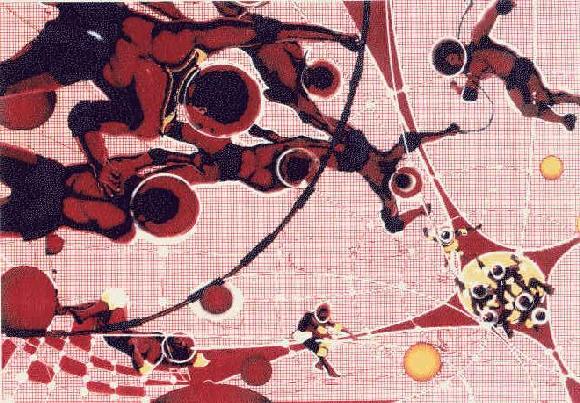
As we said above, things will start small, and grow bigger. So holding Olympic games in an orbiting zero-gravity stadium 100 meters in diameter, for example, is obviously not a realistic project in the near future. But instead of dismissing it as a ridiculous fantasy - as many "space industry" people would - consider that:
- It's unquestionably technically possible - a student could estimate the structural stresses involved.
- Its feasibility depends on straightforward business economics, and specifically on the cost of launch, and the market value of media rights.
- It's an interesting question how soon after the beginning of space tourism it will happen - it will depend mainly on the growth rate of space tourism services.
And while it would be easy to say "Orbital Olympics are at least 50 years away" we should also remember that when a new service gets really popular, business growth rates can be spectacular. For example, recently Internet-connectable personal computers and mobile-telephones have shown fantastic growth rates, with both sales and investment growing by tens of $billions per year in just a single country! Why shouldn't there be a global "space tourism boom" on a similar scale? In that case it could lead to spectacular growth rates. And before space tourism reaches a scale of even 1 million passengers per year, large-scale sports facilities will certainly be built in orbit - because they'll be good business investments for hotel companies.
An incentive for business?
For such a boom to happen there are plenty of spare resources - since the end of the cold war the aerospace industry has had nothing else to do: employment has already shrunk by millions world-wide; the number of companies has dropped sharply; and it isn't over yet. There's talk of further reduction in the number of helicopter makers, satellite makers and launch vehicle makers! So it could be a case of "Light the blue touch-paper - and stand back!" We look forward to it.





 Back
Back